Reflections from the Climate Asia Conference, Day 1 | India Habitat Centre, New Delhi
by Khyati Bhardwaj | The Azadi Project
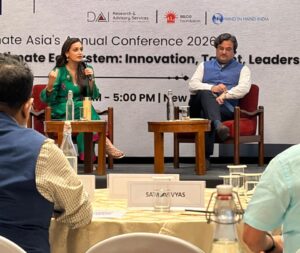
The India Habitat Centre in New Delhi played host to the Climate Asia Conference’s Day 1, a full-day gathering of climate finance experts, policy thinkers, civil society representatives, and development practitioners trying to answer one of the hardest questions of our time: how do we build climate resilience for those who need it most, and who gets to be in the room when we decide?
I attended, representing The Azadi Project, which works with marginalised and migrant women on skills and livelihoods. And while the conversations across four panels were rich and urgent, they also made visible a gap that we at Azadi know intimately.
What Was Discussed
The four panels moved through ambitious terrain. The first opened with a foundational question about the idea of place, the climate crisis is not abstract; it is everywhere, and its solutions must be rooted in human and knowledge capital. CSR was flagged as a critical challenge, not just in funding but in how it frames development discourse. The session surfaced a crucial link: gender and climate are not parallel tracks; they are the same track.
Panel 2 pushed further into the ground-level reality. How do you move from on-ground evidence to policy? Speakers noted the need for disaggregated gender data and cautioned against the fantasy of a single replicable model; what works requires a plurality of approaches, shaped by geography, community, and context. The idea of a Village Climate Resilience Index with 49 indicators was discussed, along with the tension between scaling up and preserving local knowledge.
Panel 3 turned to technology and transition — electrification supply chains, biofuels, EV adoption, with a healthy dose of scepticism about greenwashing. The point was made plainly: an EV is not automatically green. What’s needed is coordinated, long-term financing with real KPIs, not fragmented five-year investments.
Panel 4 dove into parametric and climate insurance, perhaps the most technical but also most consequential session for communities like ours. India’s agri-insurance market is worth 3.5–4 billion USD, yet penetration remains deeply inadequate. Government premium subsidies were identified as essential, the informal sector remains largely unprotected, and for women farmers especially, premiums must be designed to be low and accessible. The reinsurance market structure, actuarial risk aversion, and the need for blended capital and CSR integration all came up as systemic barriers.
The Question I Asked Dia Mirza
Actor, UN Environment Goodwill Ambassador, and the conference’s chief guest, Dia Mirza, brought both visibility and genuine conviction to the room. During the Q&A, I asked her: Refugee women and migrant women are among those most acutely affected by the climate crisis, losing homes, livelihoods, and safety to floods, displacement, and resource scarcity, yet they remain almost entirely invisible in spaces like this one. What does it mean that they are not here?
Her response was immediate and warm. She said that next year, a refugee woman should be at this conference, not as a subject of discussion, but as a voice in it. That the people closest to the crisis must be closest to the conversation.
It was the right thing to say. And we intend to hold that vision accountable.
Why Team Azadi Was Here
The Azadi Project works at precisely this intersection: women who have been displaced by conflict and circumstance, who now navigate precarious livelihoods in cities ill-equipped to absorb them, and who will bear the next wave of climate disruption with the fewest resources to survive it. Climate finance, insurance design, gender-disaggregated data, coalitions of micromovements rather than top-down scaling, all of this is our work, even when our communities are not yet named in these rooms.
We were at Climate Asia because these conversations matter. And we’ll keep coming back until the women we work with are in them too.
—
Leave a Reply