
Not Just Teaching, But Healing
By Iqra Qayoom Program Trainee, Social Media and Community Educator Alum, Azadi Leadership Program 2024
When I first joined the Khush Azad Kaabil Women’s Center in October 2025, I did not know how much the journey would change me. It shaped me not only as a teacher, but as a person.
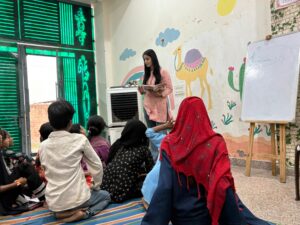
Walking into that classroom for the first time, I was not just stepping into a teaching role. I was stepping into the lives of children carrying stories heavier than their age.
It was not my first time teaching. I had taught kids back in my hometown, but this felt completely different. These were children who had seen displacement, economic instability, difficult home situations, and deep uncertainty. That reality stayed with me from the very first day.
Gaining their trust took time. Many of them were not comfortable with someone new, and I understood that. Accepting a teacher from a different place, a different background, is not simple. I had come in thinking my job was to teach from textbooks. I quickly realised it was much more than that. Whatever I taught had to mean something. I began asking myself: Am I doing enough? Is any of this making a difference? Am I the right person for this? The question that stayed with me most was a simple one: will I turn out to be a good teacher for them? I wanted, more than anything, to give them something they could carry forward.
What I did not expect was how much they would give me in return. With their warmth and openness, I found my footing. We started small: smiles, laughter, games, activities, and their favourite movie screenings. Those small things built something real between us.
Slowly, I started seeing changes. A shy child who had barely spoken began raising her hand to answer questions. The most restless kids started reminding others to settle down. Each of those moments gave me something I had not known I needed.
I was learning from them as much as I was teaching them. Teaching, I came to understand, is not only about delivering lessons. It is about patience, about paying attention, about recognising that every child learns differently and at their own pace, shaped by everything they have lived through. It is about building a space where they feel valued and, most of all, safe. These girls showed me what resilience looks like. Many of them manage household responsibilities before they arrive. They come in tired, and they still pay attention. That is not something I take lightly.
There is a kind of fulfilment in this work that I had not found anywhere else. When I received my Master’s degree, I felt proud. But it did not compare to the day a child looked up at me and said: “Ma’am aap humein acha padati ho.” Ma’am, you teach us really well.
There is still a long road ahead. The challenges are real, and life has not been easy for these children. But their laughter fills the room. Hope shows up in small things: a smile, a conversation, a child who begins to believe in herself.
They show up every day with curiosity and energy. They remind me, every single day, why this work matters.
Teaching children from migrant and marginalised communities is not always easy. But if we can play even a small part in shaping their lives, then every moment of doubt, every hard day, every effort, is worth it.