
By Chaity P. Sarkar
There was a time when trees did not have to justify their presence in the cities.
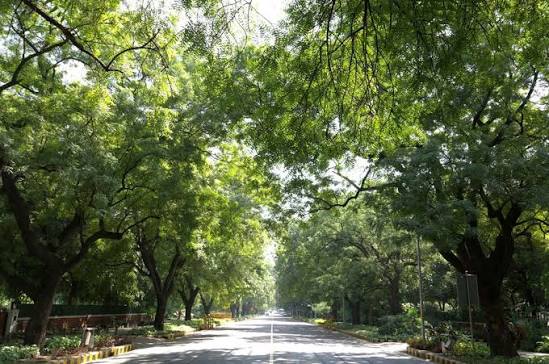
They were simply part of neighbourhoods. Older than the building surrounding them. A silent member of images from our youth and childhood. In Kolkata, where I grew up, there was nothing remarkable about the trees scattered across the city. They were all similar-looking, tall, older than memory, and sometimes backdrops of photos in our albums. They were not remarkable enough to campaign for, except for some young saplings used as a photo-op by local dadas (local politicians or local goons).
Most trees that I can recall were prehistoric. Every locality had a Banyan tree that someone insisted was haunted after dark. The gulmohar that turned the pavement red every summer. Random cotton trees in full bloom (usually causing allergies). When a storm took down a branch, that was the week’s event. Kakus (uncles) debated whether the tree was “weak now” or just unlucky. Someone’s roof was grazed every monsoon.
In school, we learnt about the famous Chipko Movement. Women hugging trees so they would not be cut down. It was presented as history, an extraordinary act from another time, another place (the fact that we were referring to tribal women was either forgotten or not considered important enough to mention). We memorised the chapter, wrote some tests, made a presentation, and moved on.
No one prepared us for the possibility that, decades later, we would spend our time on social media scrolling and reading posts and reports announcing the felling of thousands and lakhs of trees at a time across the country. And these are not illegal felling or “jhoom” (slash and burn) agriculture that ruins forests. This mass destruction comes with a label of “development”.
According to a DNT analysis, 28 Lakh trees are set to be cut down across India to make way for roads, railways, mining, data centres and so many more things. There are protest from citizens that briefly enters the news (only via social media) before making way for the next announcement. At the moment, Delhi’s Sarojini Nagar is in the news. Then came the news for Hasdeo forest in Chhattisgarh. Earlier, it was the Aravallis. Before that, it was Jaipur, Mumbai, Karnataka, and Assam.
Today, trees in India are only in the news when they’re about to disappear. When these trees have to make way for more important development projects.
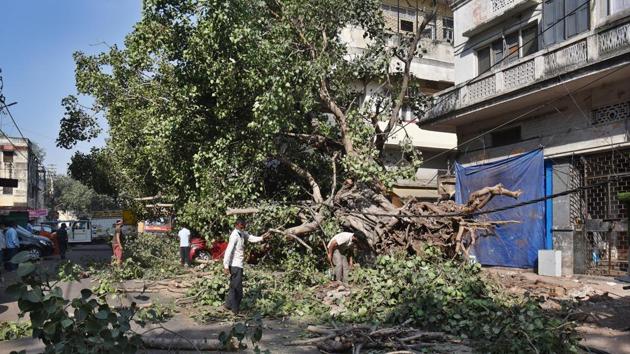
There is a peculiar helplessness in watching this unfold from home. We read the numbers, close the article, close the app, continue with our day, and repeat the process when the next city appears on social media. The next tragedy of a community protesting against this loss. Till the buzz fades away.
I don’t think this is nostalgia talking, or at least I hope it isn’t only that. It’s the specific unease of realizing that the ordinary, unremarkable, slightly haunted trees of my childhood were never actually guaranteed.
Because the loss of trees across the country is not only about the loss of forests and loss only for tribal communities. It includes cities and the commons shared among its citizens. The accessible spaces. The locally shared resources. As our cities get hotter, this includes the loss of shade and clean air. It also marks the loss of local histories. It’s a loss for ordinary people like us who are losing access to natural resources and city heritage.
Important Links:
https://www.downtoearth.org.in/forests/over-28-million-trees-on-forest-land-approved-for-felling-in-three-years-dte-analysis-finds
https://www.downtoearth.org.in/forests/hasdeo-under-siege-forests-tribes-and-the-fight-against-corporate-coal#:~:text=Similar%20concerns%20surround%20the%20Kente%20Extension%2C%20with,empowers%20tribal%20communities%20to%20protect%20their%20forests.
https://www.downtoearth.org.in/forests/6-944-608-trees-cut-across-india-in-last-three-years-moef-cc-67936
All photos are sourced externally.
Leave a Reply